Early Career Deep-Sea Expedition Leadership Master Class and Fellowship

Watch the COBRA webinar about the 2023 program
https://www.youtube.com/watch?v=lpFV4IdAiDk

Overview of the COBRA Early Career Master Class and Fellowship
The Crustal Ocean Biosphere Research Accelerator (COBRA) is an international research coordination network to accelerate research on the structure, function, resilience, and ecosystem services of the crustal ocean biosphere to inform decision making, particularly related to deep-sea mining and subseafloor carbon sequestration. COBRA has four primary activities to achieve this mission, as outlined in the COBRA Logic Model:
- Coordinate: Bring together interested parties to prioritize and plan research
- Accelerate: Leverage opportunities, support research exchanges, and harness data
- Translate: Bring findings to policy-makers, industry, and the public
- Educate: Train early career researchers in ocean exploration, science and policy
COBRA is an endorsed action of the United Nations’ Decade of Ocean Science for Sustainable Development.
The centerpiece of the Education activity of COBRA is a “Master Class” that trains early career researchers (ECRs) in deep-sea expedition planning from start to finish. The Master Class – delivered virtually and ending with an in-person event over the course of 12 weeks – is designed to equip participants with the skills and tools to successfully design, propose, execute, and report on deep-sea oceanographic field research with a collaborative approach. Topics covered include reviewing the types of assets for conducting deep-sea research and exploration, funding and proposal writing tips, developing concepts through respectful and reciprocal engagement with others, cruise preparation how-to, at-sea operations planning, using telepresence for research and outreach, permitting and reporting, data management, and ocean law. Request access to COBRA Master Class course materials formerly available on the COBRA Master Class PubPub for examples of training materials. A variety of international subject matter experts provide instruction, broadening the participants’ networks. Participants apply their learning through the design of an independent project.
As an international network, COBRA seeks participation from around the world, with an intention to create a large collaborative pool of talent engaged in leading deep-sea research that addresses societal needs. With sponsorship of the 2027 COBRA Master Class by the Schmidt Ocean Institute, we will prioritize preparing participants to leverage the future cruise track and priorities of the Schmidt Ocean Institute’s RV Falkor (too). In this context, an ECR is defined as a senior graduate student, postdoctoral scientist, junior faculty less than 10 years from their terminal degree, and/or other junior professionals such as an early career employee of a government, non-governmental organization/non-profit, or company. Previous hands-on experience with deep-sea research, outreach, or policy is not required. Participants are considered COBRA Fellows for the 2027 calendar year and are eligible for additional COBRA leadership training opportunities.
Participants selected for the virtual Master Class training opportunity are eligible to receive travel funds to support their in-person participation in the final week of the Master Class April 12-14 at the Bigelow Laboratory for Ocean Sciences in the U.S. State of Maine. Eligible travel costs include transportation, accommodation and allowed per diem for meals to be reimbursed after submission of expense receipts. Reimbursement for economy/coach fares only is allowable for the most cost effective route. If participants require visas for travel, we will fund those costs, but it is the responsibility of the participant to work with their home institution on securing the necessary visas. Funds will be reimbursed after submission of expense receipts and offered as either a bank account or PayPal transfer after submission of US Internal Revenue Service Forms W9 or W8, as appropriate depending on taxpayer status, to COBRA’s Managing Director. This training program, the 2027 COBRA Master Class, does not include any employment by the Bigelow Laboratory for Ocean Sciences, which administers COBRA funding.
Format and Schedule of the 2027 Master Class
The 2027 Master Class will be held for 12 weeks beginning January 12, 2027 and ending April 14, 2027. The first 11 weeks will be held as synchronous virtual sessions on Tuesdays from 12:00-2:00PM US Eastern time using Zoom (note: US time change on March 14 from UTC-5 to UTC-4), and the final week will be held in person April 12-14 at the Bigelow Laboratory for Ocean Sciences in the U.S. State of Maine. In addition to these mandatory synchronous sessions, asynchronous learning and networking is supported by the Master Class website intranet and a dedicated Slack channel. NOTE: Please do NOT apply if you cannot commit to attending the synchronous virtual sessions or cannot commit to attending the final week in person (travel days April 11 and April 15). Virtual sessions on Tuesdays 12-2PM US Eastern time, AND the in-person final week are BOTH essential requirements of your application and participation.
In each week of the virtual Master Class, participants are expected to:
- invest about 30 minutes of asynchronous time on course preparation “homework” distributed through the COBRA Master Class website and/or Slack channel.
- participate in a synchronous live training and discussion session held using the Zoom video-conferencing platform. Note: these events will be recorded for internal distribution only, for participants who cannot make a class date or want to refresh learning. Recordings of discussion sections will NOT be made public, to protect vulnerable questions or conversations.
- engage in conversation with other participants and instructors using a dedicated Slack channel.
The virtual Master Class content will be offered in the English language, and participants are asked to communicate in English. We will use live transcription to facilitate accessibility and language translation. Though COBRA is an international network, the instructors are all US-based, but course-content will include non-US-based resources, programs, and guest instructors frequently.
Participants are expected to use their own computing devices with microphones, cameras, and internet access to participate in this virtual Master Class. If this is difficult for a participant to implement, accommodations are available for hardware and connectivity support. Participants are also expected to be able to connect to the Master Class using their own Google, Slack, and Zoom accounts, and to be able to access content on YouTube.
Schedule:
- August 27, 2026 – Application period opens
- October 1, 2026 – Application period closes, evaluation begins
- November 16, 2026 – Candidates notified of selection
- January 12, 2027 – Virtual Master Class begins
- March 23, 2027 – Virtual Master Class ends
- April 12-14, 2027 – In-person conclusion of the Master Class
Application Process
Complete the online application form by October 1, 2026.
About the application form:
The application form will ask for the following mandatory information:
- Name and contact information
- Current institution, country of institution, and career stage
- Name of supervisor, if applicable
- Current country of residence
- Country of citizenship (for visa purposes)
- A 2-page PDF document with applicant’s current resumé or curriculum vitae including:
- Education background
- Professional affiliations
- Awards or honors
- Service to or participation in scientific, education, mentoring or policy activities
- Up to 5 relevant publications or other types of professional activities
- Note: if you have not created a 2-page CV before, refer to this guidance from COBRA
- Short Answer (300 words or fewer): Describe your career goals, how participating in the Master Class will help you to achieve them, and how they align with COBRA’s mission.
- Short Answer (300 words or fewer): Describe how you would contribute to COBRA’s goal to expand the pool of talent engaged in leading deep-sea research that addresses societal needs.
- Multiple Choice: Are you available to participate in the mandatory synchronous virtual Master Class held on Tuesdays from 12-2PM US Eastern time between January 12 – March 23, 2027? Note: A US time change occurs on March 14 from UTC-5 to UTC-4.
- Multiple Choice: Are you available to participate in the mandatory in-person Master Class held on April 12-14, 2027 at the Bigelow Laboratory for Ocean Sciences in the U.S. State of Maine? Note: Travel days expected on April 11 and April 15.
- Short Answer: What services can COBRA provide to make the virtual Master Class accessible to you? (for example, if you lack access to internet connectivity, or would benefit from a language translation service)
- If you used an AI tool to help develop this application, describe how it was used
Selection Criteria and Process
To intentionally limit implicit bias in the selection process, COBRA does not use ranking for selection. Instead, candidates are randomly selected from a pool of eligible candidates. Eligibility is determined by the COBRA Executive Committee based on the following criteria:
- Be an advanced graduate (Ph.D.) student, postdoctoral scientist/researcher, untenured faculty, or an early career employee of a government, nongovernmental organization (NGO), or industry.
- Have sufficient experience (academic/industry/other) to benefit from and contribute to the 2027 COBRA Master Class.
- Demonstrate a strong interest in deep-sea exploration and research, at sea and/or from shore.
- Provide compelling reasons for wanting to take part in the COBRA Master Class and alignment of goals with COBRA’s mission.
- Provide compelling reasons for wanting to contribute to COBRA’s goal to expand the pool of talent engaged in leading deep-sea research that addresses societal needs.
- Be available to participate in the synchronous sessions of the virtual Master Class and the final week in person at Bigelow Laboratory for Ocean Sciences in the U.S. State of Maine.
Candidates will be notified by email of their selection status. Selected candidates will have 14 days to confirm acceptance to participate in the program by completing an online acceptance form. Where applicable, selected candidates must provide proof of supervisor approval to participate in the Master Class. All candidates must agree to abide by COBRA’s Code of Ethics and Professional Conduct to treat everyone with dignity and respect and communicate with civility for acceptance into the program.
Future Master Classes
Sign up for the COBRA newsletter to be notified of the next COBRA Master Class opportunity.
For More Information
- Request access to COBRA Master Class course materials formerly available on the COBRA Master Class PubPub
- Learn about the Master Class and an initial assessment of the first Master Class published in Frontiers in Marine Science (October 6, 2023): COBRA Master Class: Providing deep-sea expedition leadership training to accelerate early career advancement
- Hear from the 2024 COBRA Fellows on the Master Class in Deep-Sea Life (DOSI/DSBS Newsletter, September 2024): Top Takeaways from the 2024 Early Career Deep-Sea Expedition Leadership Masterclasss
- Hear from the 2023 COBRA Fellows on the Master Class in Deep-Sea Life (DOSI/DSBS Newsletter, August 2023): Transferable Knowledge in Deep-Sea Expedition Leadership: Take-homes from the 2023 COBRA Master Class
- Learn about the Master Class in Deep-Sea Life (DOSI/DSBS Newsletter, January 2023): Accelerating Deep-Sea Expedition Leadership via a New COBRA Master Class
- Watch the 2022 COBRA webinar about the 2023 Master Class
2026 Master Class and Fellowship
The 2026 Master Class was held virtually January to April 2026, ending with an in-person Capstone Experience with a mix of Fellows from 2022-2025.
2025 Master Class and Fellowship
 The 2025 Master Class was held virtually January to April 2025.
2024 Master Class and Fellowship
 The 2024 Master Class was held virtually February to May 2024.
2023 Master Class and Fellowship
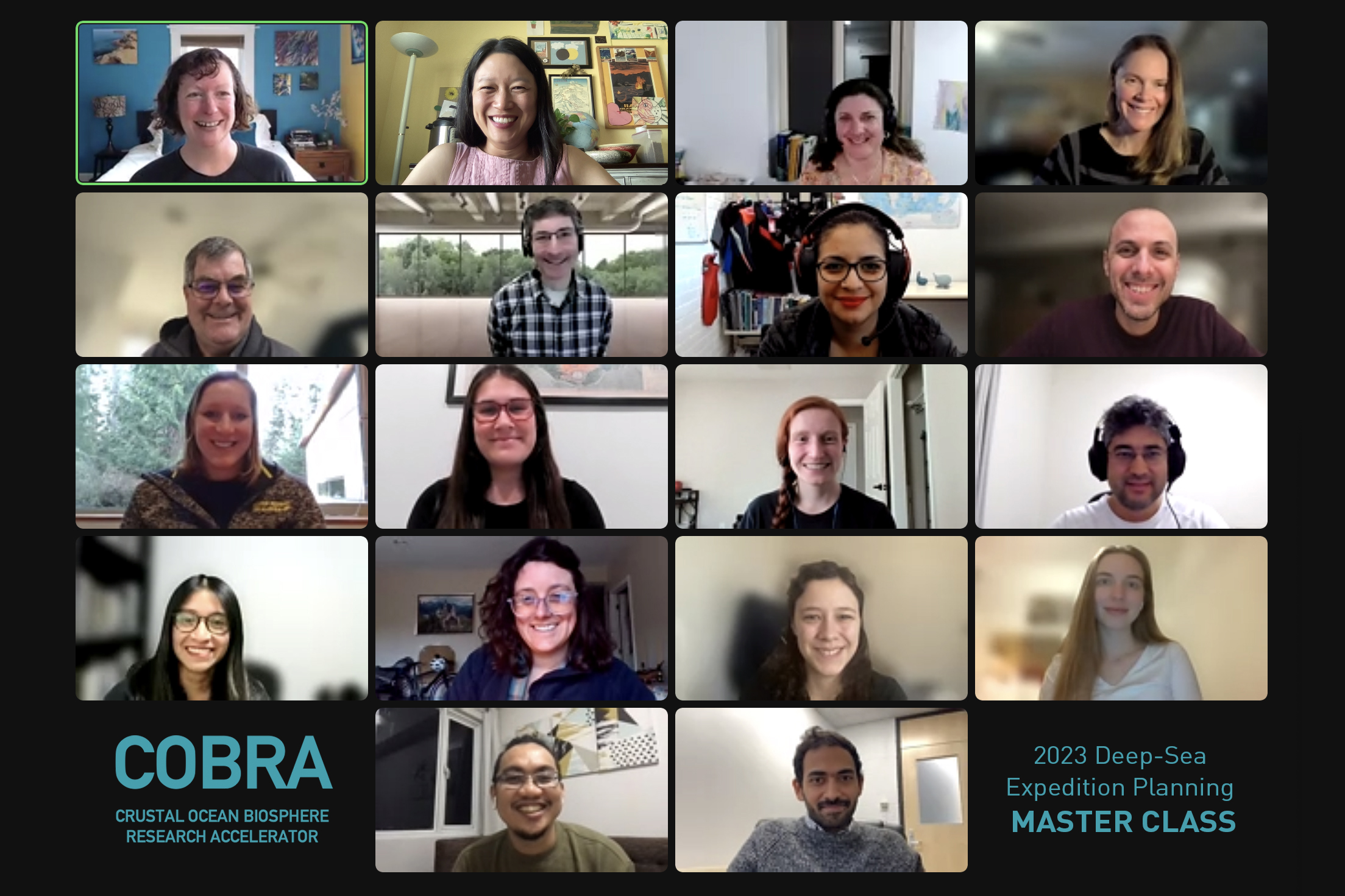 The 2023 Master Class was held virtually February to May 2023 with the opportunity for remote participation in a leveraged “shakedown” expedition of the RV Falkor (too) in June 2023. This Schmidt Ocean Institute sponsored expedition intends to explore seamount ecosystems in the Pacific Ocean within Costa Rica’s Exclusive Economic Zone to inform conservation of biodiversity.
2022 Master Class and Fellowship
 The inaugural Master Class was held virtually from March to May 2022 and partnered with a telepresence-enabled deep-sea expedition of the Ocean Exploration Trust’s (OET) E/V Nautilus. This expedition was part of a series exploring seamounts within and around the Papahānuamokuākea Marine National Monument (PMNM).
